

Are you feeling overwhelmed and looking for a proven way to find calm? You are not alone. Stepping into the world of mindfulness can feel intimidating, but finding the right meditation classes for beginners offers the perfect foundation to transform your daily routine and ease your mind.
This comprehensive guide breaks down everything you need to know to confidently start your mindfulness journey. We explore different types of practices, compare online and in-person options, outline exactly what to expect during your first session, and share expert tips to help you avoid common rookie mistakes while building a sustainable habit.
Why You Should Consider Structured Learning
Taking the first step toward a calmer mind often brings up questions. Many people try sitting quietly for five minutes, only to find their minds racing faster than before. This common hurdle is exactly why guided instruction matters. When you search for meditation classes for beginners, you are looking for more than just silence; you are looking for a framework.
A structured environment provides a clear roadmap. Instead of wondering if you are breathing correctly or sitting properly, a qualified instructor guides you through each phase of the practice. This professional guidance helps you bypass the frustration that often causes new students to quit prematurely. Instructors can validate your experiences, answer your specific questions, and adjust techniques to suit your personal needs.
Furthermore, committing to a class creates accountability. When you schedule a specific time for your practice, you are much more likely to show up. This consistency is the secret to unlocking the true benefits of mindfulness. Whether you want to improve your focus, lower your stress, or simply learn how to exist comfortably in the present moment, structured meditation classes for beginners give you the tools to succeed.
To dive deeper into related practices, you might want to explore our guides on breathing exercises and stress management techniques.
The Science Behind the Practice
Research consistently backs the benefits of regular meditation. According to high-authority health institutions like the [American Psychological Association], consistent mindfulness practice reduces anxiety, improves emotional regulation, and even physically alters the brain structures related to stress and focus.
When you join meditation classes for beginners, you tap into these scientifically proven benefits under expert supervision. The guidance ensures you practice techniques that genuinely activate your body’s relaxation response, rather than just sitting and worrying with your eyes closed.
Popular Types of Meditation Classes for Beginners
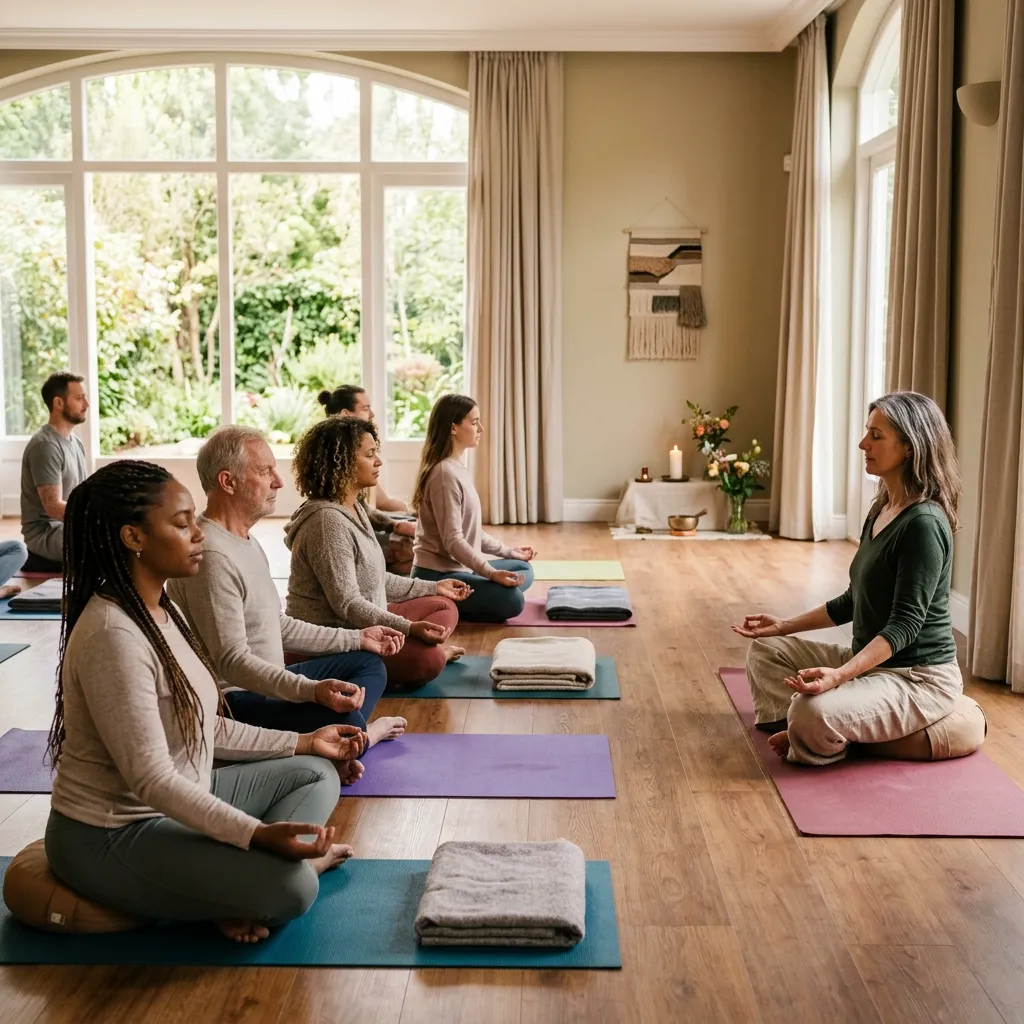
Not all practices feel the same. The beauty of mindfulness is the sheer variety of approaches available. Finding the right style for your personality and goals makes all the difference in your long-term success.
Mindfulness Meditation
Mindfulness serves as the foundation for most modern practices. These meditation classes for beginners teach you how to remain acutely aware of the present moment without judgment. You will learn to observe your thoughts passing like clouds in the sky, acknowledging them without getting swept away. This style is excellent for people who struggle with overthinking and want to cultivate a deep sense of everyday awareness.
Vipassana (Insight) Meditation
Vipassana translates to seeing things as they really are. While traditional Vipassana retreats last for ten days, many studios offer modified meditation classes for beginners that introduce the core concepts. The practice involves scanning your body for physical sensations and observing them without reacting. It requires patience but offers profound insights into the mind-body connection.
Guided Visualization
If you find focusing on your breath too difficult, visualization offers a highly engaging alternative. In these sessions, the instructor leads you through specific mental imagery. You might picture a tranquil forest, a glowing light, or a scenario that promotes healing and relaxation. These meditation classes for beginners are particularly effective for stress relief and anxiety reduction, giving your active mind a specific task to focus on.
Transcendental Meditation (TM)
While usually taught in specialized centers, TM is highly popular. This technique involves silently repeating a specific mantra assigned by a teacher. You practice it for twenty minutes twice a day. Though the official courses require an upfront investment, many local centers offer introductory meditation classes for beginners to explain the methodology and science behind the practice.
For more specialized approaches, you can check out our resources on guided meditation benefits to see how vocal instruction impacts brain waves.
Choosing Between In-Person and Online Formats

The digital age gives us incredible flexibility. You can join a local studio or connect with a teacher across the globe. Both formats offer distinct advantages, and your choice depends entirely on your lifestyle, budget, and personal learning preferences.
The In-Person Studio Experience
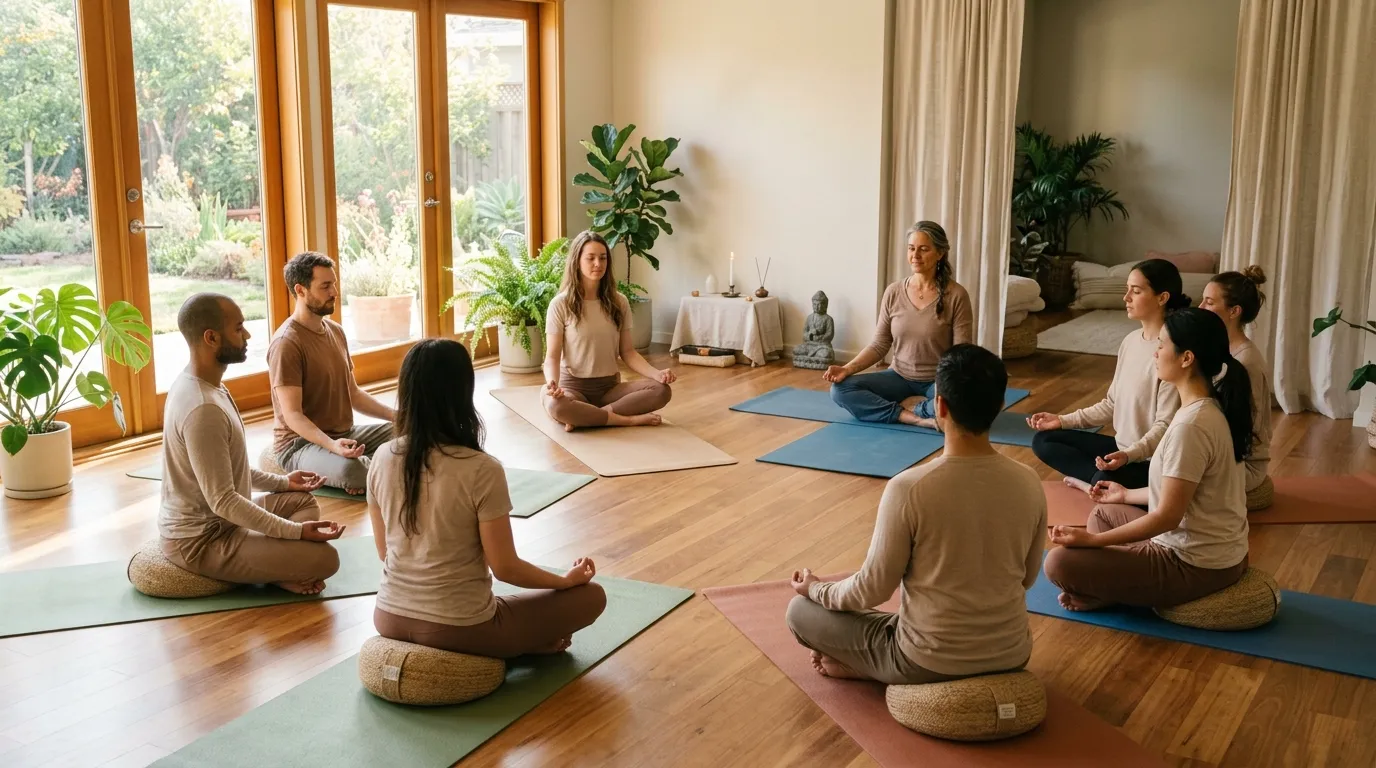
Walking into a dedicated mindfulness studio immediately shifts your headspace. The environment is purposefully designed to promote calm, with soft lighting, comfortable cushions, and minimal distractions.
Taking in-person meditation classes for beginners allows for direct interaction with the instructor. They can correct your posture, notice if you are struggling, and offer immediate, personalized feedback. Additionally, practicing alongside others creates a powerful shared energy. The community aspect often helps new students feel supported and less isolated in their struggles.
The Digital Advantage
Online platforms have revolutionized accessibility. Virtual meditation classes for beginners remove the barrier of a commute, allowing you to practice in the comfort of your own home. This is ideal for busy parents, professionals with unpredictable schedules, or anyone who feels self-conscious about practicing in a group setting.
Many high-quality apps and websites offer live-streamed sessions where you can still interact with the teacher via chat or video. Furthermore, digital options are often much more budget-friendly than physical studio memberships.
Format Comparison Table
|
Feature |
In-Person Classes |
Online/Virtual Classes |
|---|---|---|
|
Instructor Feedback |
Immediate, physical posture corrections |
Verbal guidance, limited visual correction |
|
Community Aspect |
High, easy to meet fellow students |
Moderate, relies on chat or forums |
|
Convenience |
Requires travel and fixed scheduling |
High, practice anywhere, anytime |
|
Cost |
Generally higher per session |
Usually lower, often subscription-based |
|
Environment |
Controlled, distraction-free studio |
Relies on your home environment |
Whether you choose a physical studio or a digital platform, the most important factor is consistency. Pick the format that removes the most friction from your daily routine, ensuring you actually attend your meditation classes for beginners.
What to Expect in Your First Session
Fear of the unknown often keeps people from trying new things. Knowing exactly what happens during meditation classes for beginners can ease your nerves and help you approach the experience with an open mind.
The Initial Setup
When you first arrive, whether logging into a Zoom room or walking into a studio, the atmosphere will be quiet and welcoming. You do not need to sit in a pretzel-like lotus position. Instructors emphasize comfort above all else. You can sit on a cushion, use a chair, or even lie down if the class style permits.
The Core Practice
Most meditation classes for beginners follow a similar structure.
- Settling In: The teacher will spend the first few minutes helping you ground yourself. This usually involves deep breathing exercises to signal to your nervous system that it is time to relax.
- The Main Guidance: The instructor will provide a focal point. This might be the sensation of your breath, a specific phrase, or the sounds in the room. They will speak periodically to gently guide your wandering mind back to the present.
- Periods of Silence: Do not expect non-stop talking. There will be pockets of silence allowing you to practice the technique independently.
- The Closing: The session will end with a gradual return to full awareness. The teacher might ring a soft bell and invite you to slowly open your eyes and stretch.
Post-Class Discussion
Many meditation classes for beginners reserve time at the end for questions. This is an invaluable opportunity to share your experience. If you felt sleepy, distracted, or irritated, share those feelings. Your instructor will validate your experience and offer practical advice for your next session. To learn more about navigating post-class feelings, read our article on developing emotional resilience.
Essential Preparations and Gear
You do not need to spend hundreds of dollars to start meditating. The practice is inherently minimalist. However, a few basic preparations can make your first few meditation classes for beginners much more comfortable.
Clothing Choices
Wear clothes that allow you to breathe deeply and sit comfortably. Avoid tight waistbands, restrictive denim, or heavy fabrics. Yoga pants, sweatpants, or loose-fitting shorts are ideal. Layers are also highly recommended, as your body temperature can drop slightly when you sit still and relax.
Creating a Home Setup
If you are taking virtual meditation classes for beginners, dedicate a small corner of your home to your practice. You do not need an entire zen room. A quiet corner in your bedroom works perfectly. Let your family or roommates know you need uninterrupted time, put your phone on do not disturb, and consider dimming the lights to reduce visual stimulation.
Basic Equipment
While a chair works perfectly fine, investing in a traditional meditation cushion (zafu) can vastly improve your posture. A zafu elevates your hips above your knees, allowing your spine to maintain its natural curve without muscular strain. A soft mat (zabuton) placed underneath protects your ankles and knees from hard floors.
Common Mistakes to Avoid
When you first start exploring meditation classes for beginners, it is easy to fall into a few common traps. Recognizing these pitfalls early will save you frustration and help you build a more joyful practice.
Forcing the Mind to be Blank
This is the single biggest misconception about mindfulness. Meditation is not about stopping your thoughts. If you try to force your mind to go blank, you will only create more tension. The goal of meditation classes for beginners is to teach you how to relate to your thoughts differently. When a thought arises—and it will—you simply notice it and gently return your focus to your breath.
Judging Your Performance
There is no such thing as a “good” or “bad” meditation session. Some days your mind will be calm, and other days it will feel like a chaotic storm. Both experiences are completely valid. Judging a session as “bad” because you were distracted defeats the purpose of the practice. The act of noticing you are distracted is, in itself, a moment of profound mindfulness.
Inconsistent Practice
Attending one class a month will not yield significant results. Mindfulness is akin to going to the gym; it requires regular repetition to build mental muscle. It is far more effective to practice for ten minutes every day than to sit for an hour once a week. Use your meditation classes for beginners as a springboard to establish a short, daily home practice. If you need help building habits, refer to our guide on building daily routines.
Pro Tips and Expert Insights
To get the absolute most out of your meditation classes for beginners, consider these insights from experienced practitioners and teachers.
Start Small
Do not commit to a 60-minute silent sit right out of the gate. Look for meditation classes for beginners that offer shorter guided sessions, typically ranging from 15 to 30 minutes. Building your tolerance for stillness gradually prevents burnout and keeps you motivated to return.
Anchor Your Practice
Connect your new habit to an existing one. If you take online meditation classes for beginners, schedule them immediately after brushing your teeth in the morning or right before you drink your evening tea. This behavioral strategy, known as habit stacking, makes it much easier to integrate mindfulness into a busy life.
Be Patient with the Process
The benefits of mindfulness compound over time. You might not feel deeply transformed after your first week of meditation classes for beginners. However, after a month or two, you may suddenly notice that traffic no longer enrages you, or that you bounce back from stressful work emails much faster. Trust the process and give the practice time to work its subtle magic on your nervous system.
Expanding Your Practice Over Time
Once you complete a series of meditation classes for beginners, you might wonder what comes next. The journey of mindfulness is lifelong, and there are countless ways to deepen your understanding and experience.
Exploring Retreats
After establishing a solid baseline, a weekend retreat can rapidly accelerate your progress. Unlike standard meditation classes for beginners, retreats offer total immersion. They remove the distractions of daily life, allowing you to experience extended periods of deep focus. While challenging, they often provide massive breakthroughs in self-awareness.
Integrating Mindfulness into Daily Tasks
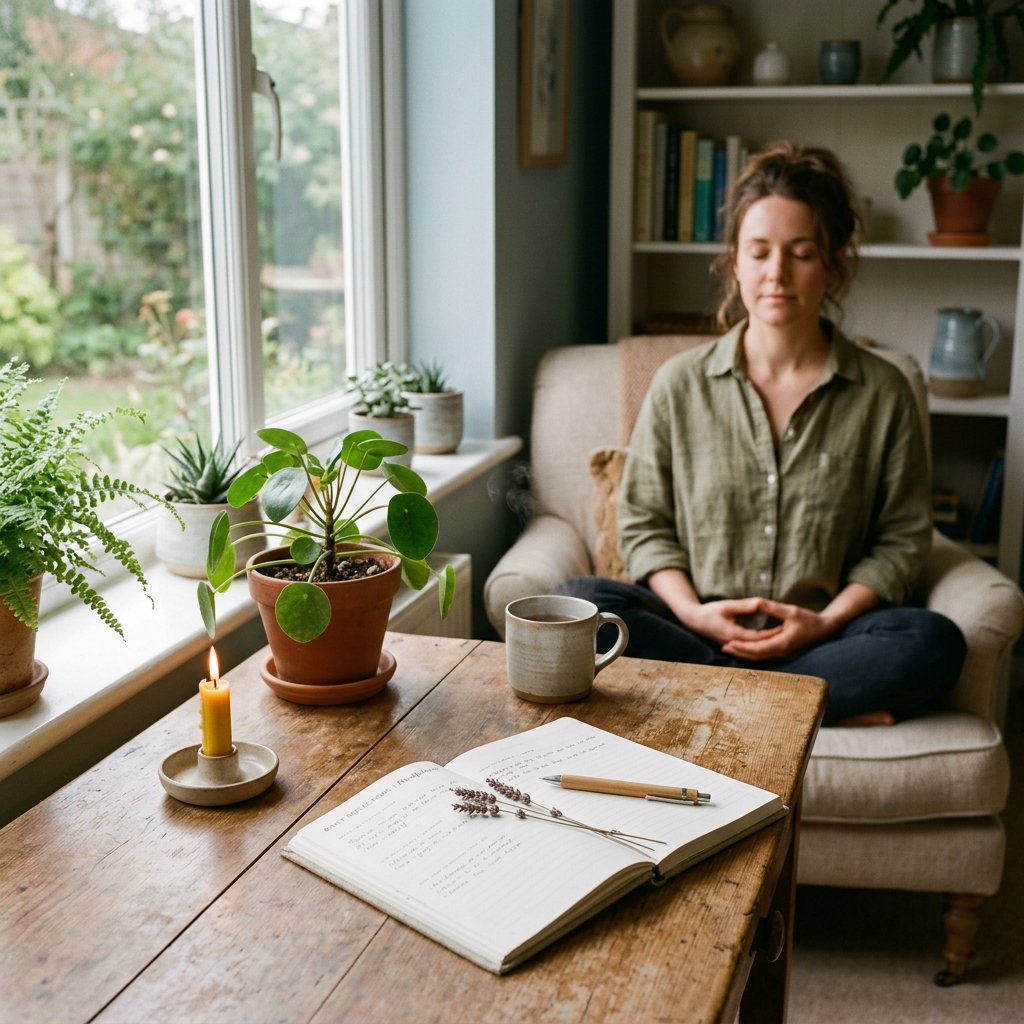
The ultimate goal of taking meditation classes for beginners is not just to feel peaceful while sitting on a cushion, but to carry that peace into your everyday life. Begin practicing mindful walking, mindful eating, or mindful listening. Try to bring the same non-judgmental awareness you learned in class to the simple act of washing dishes or walking your dog.
Joining a Community
Mindfulness can feel isolating if you practice strictly alone. Seek out a local “sangha” or sitting group. Continuing your practice alongside peers who have also graduated from meditation classes for beginners provides invaluable emotional support, diverse perspectives, and lasting friendships rooted in shared growth. You can explore our community resources focused on mindfulness techniques to connect with like-minded individuals.
Final Thoughts on Your New Path
Choosing to prioritize your mental health is a massive step forward. By doing the research and preparing properly, you take the friction out of learning a new skill. Embrace the awkwardness of the first few sessions, lean on your instructors, and celebrate small victories. With patience and consistency, the techniques you learn will become second nature, offering you a lifelong sanctuary of calm amidst a chaotic world.
Conclusion
Embarking on a mindfulness journey transforms how you interact with your thoughts and the world around you. By choosing the right meditation classes for beginners, staying consistent, and avoiding common pitfalls, you build a foundation for lifelong mental clarity. Ready to find your calm? Sign up for a local or virtual introductory class today and take your first conscious breath toward a healthier mind.
FAQs
1. What exactly are meditation classes for beginners?
Meditation classes for beginners are structured sessions led by experienced instructors designed to teach the fundamental techniques of mindfulness. They focus on basic posture, breathing exercises, and methods to gently manage wandering thoughts in a supportive, pressure-free environment.
2. Do I need any special equipment for my first class?
No special equipment is required to start. You can simply use a comfortable chair. However, as you progress, you might want to invest in a meditation cushion (zafu) and a supportive mat to help maintain a comfortable posture during longer sessions.
3. How long do beginner meditation classes usually last?
Most introductory classes run between 30 and 45 minutes. This usually includes a brief introduction, 15 to 20 minutes of guided practice, and time at the end for questions and group discussion. Short sessions help prevent physical discomfort and mental fatigue.
4. What if I can’t stop my mind from wandering?
A wandering mind is completely normal; it is what minds are designed to do. The goal of the practice is not to stop thinking, but to notice when you have drifted and gently bring your attention back to your anchor, such as your breath. Every time you redirect your focus, you are successfully meditating.
5. Are online classes as effective as in-person ones?
Yes, online classes can be highly effective. While they lack the physical presence of a studio, they offer tremendous convenience and accessibility. Live virtual classes still allow you to interact with instructors and participate in community discussions from the comfort of your home.
6. What should I wear to a meditation class?
Prioritize physical comfort. Wear loose, breathable clothing like yoga pants, sweatpants, or soft cotton shirts. Avoid tight belts or restrictive materials that might make deep abdominal breathing difficult. Bringing a light sweater or blanket is also recommended.
7. How often should a beginner practice meditation?
Consistency is much more important than duration. It is highly recommended to practice for 5 to 10 minutes every day rather than sitting for a single hour-long session once a week. Daily repetition builds the neural pathways necessary to form a lasting habit.
8. Is meditation linked to any specific religion?
While mindfulness practices originated in ancient Eastern traditions like Buddhism, modern meditation classes for beginners are typically secular. They focus on the scientifically proven psychological and physiological benefits of the practice, making them suitable for people of all faiths or no faith at all.
9. Can meditation help with my anxiety?
Yes. Numerous clinical studies confirm that regular mindfulness practice lowers cortisol levels, reduces stress, and helps regulate the nervous system. By learning to observe your thoughts without immediate reaction, you can significantly diminish the intensity of anxious feelings over time.
10. What is the difference between mindfulness and meditation?
Meditation is the formal practice of setting aside specific time to train the mind. Mindfulness is the overarching quality of being present and fully engaged in whatever you are doing at the moment. Meditation classes teach you the skills needed to bring mindfulness into your everyday life.
